Almost everything written about choosing hardwood is written about furniture. Dining tables, cabinet doors, cutting boards — things that sit in daylight and get looked at.
A drawer organizer doesn't do either. It lives in the dark, gets opened and shut a few dozen times a day, and is seen in three-second glances while you're reaching for a spatula.
That changes the answer to nearly every question people ask us about wood. So here's the version written for where this thing actually lives.
The Aging Story Is Different in a Drawer
You've probably read that cherry starts pale pink and darkens to a deep reddish-brown, and that walnut slowly lightens toward silver and honey. Both are true. Both are also mostly driven by light.
Your drawer barely gets any.
Cherry in a drawer still darkens — it just does it slowly, over years rather than the six to twelve months a cherry tabletop takes. It also darkens evenly, which is the part we like. Cherry furniture develops blotches where a lamp sat or a runner covered it. Yours won't, because the only light it ever gets is the same light across the whole piece, for the few seconds the drawer's open.

Walnut behaves the same way in reverse. Out in a sunny room, walnut drifts lighter and picks up a warm gray cast over the years. In a drawer, it holds its color considerably longer than it would anywhere else in your house. If you want dark and you want it to stay dark, a drawer is a good place to put walnut.
Maple barely changes anywhere, and in a drawer it changes even less. It warms slightly toward amber and mostly settles there.
The practical version: all three will change, and we're not going to pretend otherwise. But they change slowly, in a direction you can predict, and across the whole piece at once. Cherry deepens, walnut mellows, maple warms a shade. What you shouldn't get is a surprise — the blotchy, uneven shift that happens to wood living in a sunny room. Ten years in, it should read as a matured version of the wood you picked.
What Actually Matters Instead
Since the color is going to hold, the question worth thinking about is what the wood is sitting next to.
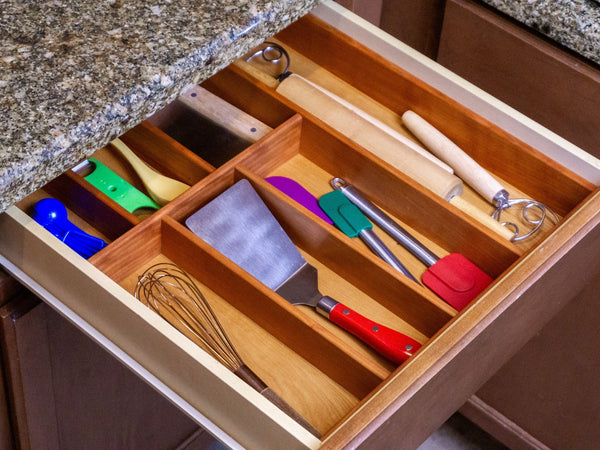
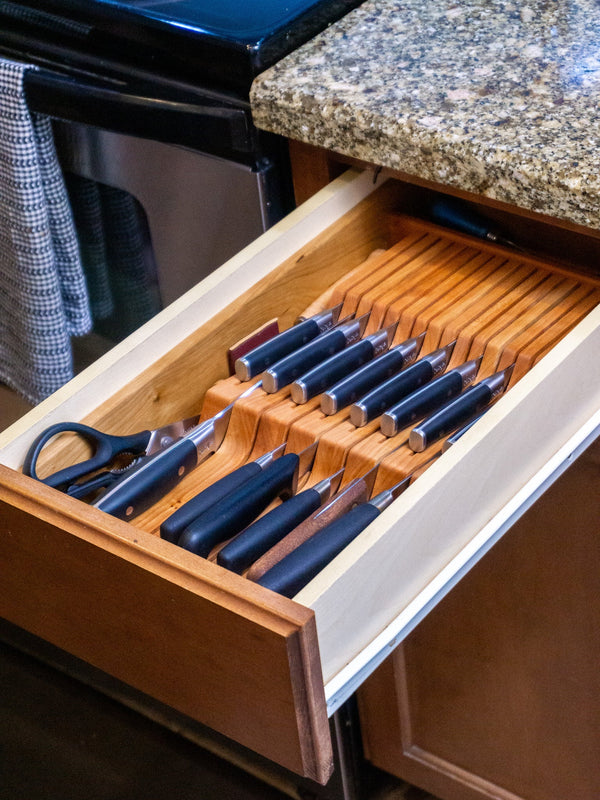
Contrast with what's in it. Stainless flatware on walnut reads as sharp and graphic — you see the shape of every fork. The same flatware on maple nearly disappears. Neither is better, but people have strong reactions once they see it. If you've got dark-handled knives or black utensils, maple is what makes them legible. If everything you own is stainless, walnut gives you the crispest contrast.
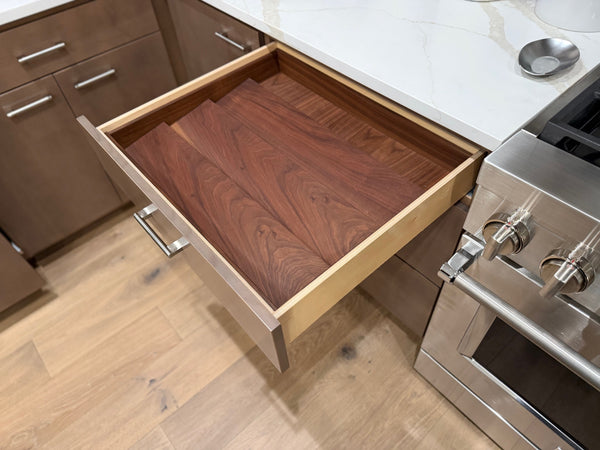
Contrast with the drawer itself. Most drawer boxes are pale — birch or maple ply. Walnut in a pale drawer box is a deliberate, high-contrast look. Maple in a pale drawer box reads seamless, like the drawer came that way. Cherry lands in between and warms as it goes.
Whether the drawer is ever open when guests are around. Sounds silly. It isn't. The utensil drawer in an island gets opened in front of people constantly, and that's the one where people almost always want walnut.
Hardness, Honestly
The Janka scale measures how much force it takes to dent a piece of wood, and people love to rank hardwoods on it. Walnut sits around 1,010, cherry around 950, maple higher than both.
For a drawer organizer, none of that matters much.
What actually leaves marks in a drawer isn't a ladle or a stack of forks. It's the pointed corner of a bottle opener getting dropped in the same spot for five years, and that'll mark any of the three about equally. These are all furniture-grade hardwoods that have been holding up in American kitchens for two centuries.
Pick the one you like. The durability question is settled before you start choosing.
While We're Here: Wood Doesn't Dull Your Knives
You'll see it claimed that a softer wood is "kinder to knife edges." It's a nice-sounding idea and it's not really how edges work.
Hardened steel is dramatically harder than any of these woods. Blades dull from cutting — from contact with boards, bones, plates, and the occasional staple in a cardboard box. A knife resting in a wooden slot isn't cutting anything.
So don't factor knife edges into your species choice. It's not a real variable.
Maintenance: Less Than You'd Think
Here's where most wood guides will lose you, because they're written about cutting boards.
Your organizer arrives dipped in food-grade, NSF-certified mineral oil. It's finished. There's nothing to apply, nothing to cure, no waiting period. Fill it the day it lands.
After that, a drawer is about the gentlest environment in a kitchen. No standing water, no direct sun, no heat, no scrubbing. Wipe crumbs out when you notice them. If a year or two in the wood looks a little dry — matte where it used to have a soft sheen — wipe on a coat of food-grade mineral oil and wipe the excess off. That's the whole maintenance program, and plenty of customers never do it at all.
Walnut's more open grain drinks oil a little faster than the other two, so it's the one most likely to want a refresh first. Maple's tight grain is the slowest to look dry.

What to avoid is short: don't run it through a dishwasher, don't leave it standing in water, don't use harsh cleaners, and don't use cooking oils like olive or vegetable, which go rancid. Mineral oil only.
They All Cost the Same
Worth saying plainly: walnut, cherry, and maple are priced identically.
Nobody should end up living with a wood they like less because it happened to be the cheaper option, so we took the question off the table entirely. Pick the one you actually want.
Where the Wood Comes From
None of it grows here. Black walnut comes out of the Midwest and the eastern states, cherry mostly from Pennsylvania, New York, Virginia, and West Virginia, and maple from across the eastern US. It all ships to Arizona, which is true of essentially every hardwood shop west of Texas.
The supply picture for all three is genuinely healthy, and that's measurable rather than a marketing line. The US Forest Service runs a continuous national count of what's standing in American forests — the Forest Inventory and Analysis program — which tracks how much of each species grows each year against how much gets cut.
On the current figures, American walnut puts on roughly 4.8 million cubic meters a year while about 1.9 million are harvested. Cherry grows about 10.3 million against 4.9 million harvested. Maple grows about 36.4 million against 16 million.
Every one of those is somewhere between two and two and a half times more wood growing than leaving the forest, and the surplus holds in every major producing state for cherry and maple, and every one but Michigan for walnut. The long view is the same story — total US hardwood growing stock more than doubled between 1953 and 2017, and the average tree being harvested today is older and larger than it was then.
Two honest caveats, because we'd rather say them than not. Those are national inventory numbers, not a certification of our specific boards; we buy through hardwood suppliers, not a chain-of-custody program. And walnut in particular takes decades to reach the size a sawmill wants, so "abundant" isn't the same as "quick to replace."
What we can say without hedging is that all three are domestic, naturally regenerating North American hardwoods growing faster than they're being used — the unglamorous, well-supplied end of the lumber world, and a very different situation from tropical imports.
The Short Version
Walnut if you want the drawer to look like a piece of furniture. Dark, high contrast, and slower to shift in a low-light spot than it would be out in a room. The one people pick for a visible island drawer.
Cherry if you want warmth without going dark. Starts light and reddish, deepens gradually and evenly over years. The most traditional-feeling of the three.
Maple if you want the drawer to read clean and quiet. Bright, tight-grained, minimal grain pattern, and the best backdrop for dark-handled tools.

Go Look at It
The fastest way to decide is to open the drawer you're planning to organize and just look at what's in it and what it's made of.
Then build your layout in our Designer and try each wood on it. Takes a minute, costs nothing, and settles the question better than any amount of reading about Janka ratings.
—Sean & Zach
— Sean & Zach